
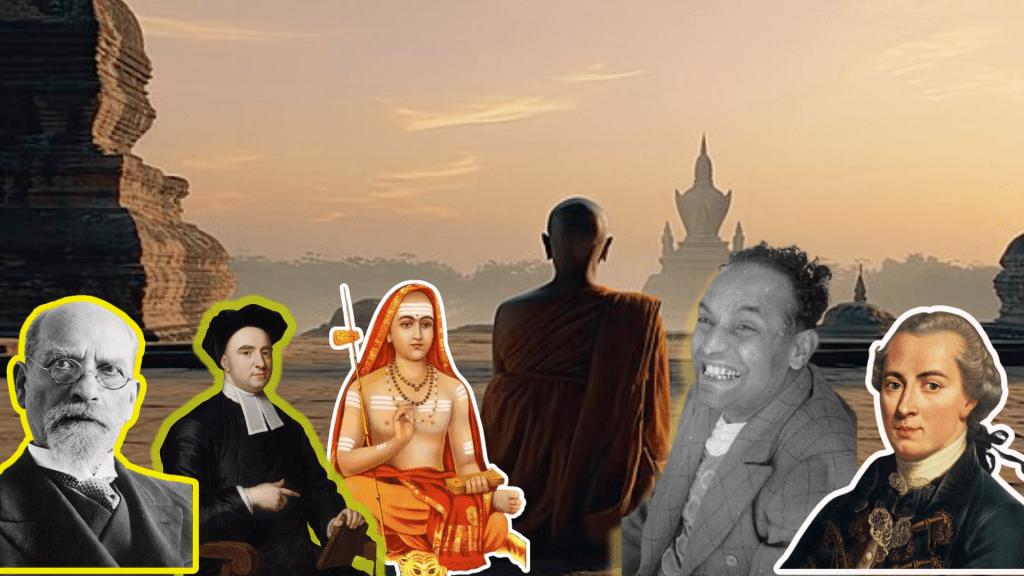
Subjective idealism is the view that the world we experience is shaped, organized, and sometimes even produced by the structures of our own perception. This idea, although most clearly articulated by the Irish philosopher George Berkeley in the eighteenth century, has deep resonances across Indian metaphysics, Buddhist psychology, analytical psychology, and world literature.
This essay presents a comparative study of how different traditions interpret the claim that mind and world are inseparable. It connects Western philosophical arguments with Indian accounts of consciousness, Buddhist analyses of cognition, Jungian psychology, and narrative experiments found in authors such as Jorge Luis Borges and Laxmi Prasad Devkota.
My goal is to offer a rigorous yet accessible discussion that will allow readers to see subjective idealism as a global theme, not a local curiosity.
1. What Philosophers Mean by Subjective Idealism
Subjective idealism states that what we call “the external world” depends on perception. In its classic form, it denies that material objects exist independently of the mind.
The most influential formulation comes from George Berkeley, who wrote in A Treatise Concerning the Principles of Human Knowledge (1710):
“To be is to be perceived.”
Berkeley argued that we never encounter matter itself. We only encounter sensory ideas in consciousness. If we remove all perceivers, then there is no longer any basis for asserting that the world exists at all. Berkeley introduces God as an ever-present perceiver who ensures that the world does not blink in and out of existence.
Berkeley’s arguments were motivated by a desire to defend common sense, religious belief, and clarity in philosophy. Yet, the consequences of his position extend far beyond eighteenth-century debates. His work created one of the most enduring metaphysical provocations in the Western tradition: is reality a product of mind rather than matter?
2. Indian Philosophical Traditions: Mind as Ground of Appearance
Long before Berkeley, Indian philosophical traditions were already investigating the relationship between consciousness and the phenomenal world. Although they do not present subjective idealism in the same form as Berkeley, they contain related insights that shed light on how perception shapes experience.
Advaita Vedānta
Advaita Vedānta, associated with the eighth-century philosopher Śaṅkara, distinguishes between the ultimate reality (Brahman) and the phenomenal world (Māyā). The world we perceive is not entirely unreal, but it is not ultimately real either. It is a transient appearance produced through ignorance (avidyā). Śaṅkara writes in the Brahma-Sūtra Bhāṣya:
“Brahman is the only reality. The world is an appearance.”
Here, perception does not create the world in the Berkeleyan sense. Instead, perception filters and distorts ultimate reality. Individual consciousness overlays names and forms onto Brahman, creating the diverse world of experience.
Advaita therefore treats perception as a creative act, although the ultimate source is Brahman, not the finite mind.
Yogācāra Buddhism
The Yogācāra or “Mind-Only” school offers the closest analogy to subjective idealism within Indian thought. Philosophers such as Asaṅga and Vasubandhu argue that external objects are not ultimately real. They are cognitive constructions produced by consciousness.
Vasubandhu’s Twenty Verses (Viṃśatikā) states:
“The so-called external things are no more than representations in consciousness.”
Yogācāra explains perception through the doctrine of ālaya-vijñāna or “storehouse consciousness,” which contains latent impressions that ripen into experiences. This is not solipsism, because multiple beings share karmic patterns that generate a coordinated world.
While Yogācāra does not assert that individual perception magically creates objects, it does argue that what appears as external reality is inseparable from the operations of consciousness. This is a psychological and phenomenological form of idealism.
3. Analytical Psychology: Jung’s Archetypes and the Construction of Meaning
In the twentieth century, Carl Jung offered a psychological counterpart to philosophical idealism. Jung did not deny the existence of a material world. However, he argued that our experience of the world is structured by deep psychical patterns known as archetypes.
In The Archetypes and the Collective Unconscious he writes:
“We do not see the world as it is but as we are.”
For Jung, the perceiving mind is not a blank slate. It contains inherited symbolic structures that shape how we interpret landscapes, events, relationships, and myths. These internal forms organize perception and meaning-making.
In this sense, the world we inhabit is always partly a projection of the psyche. Jung therefore offers a middle position between metaphysical idealism and material realism, emphasizing the role of the unconscious in world-creation.
4. Literature and the Art of World-Shaping
Literature provides a vivid demonstration of how perception, narrative, and imagination create realities. Authors across cultures use narrative voice, symbolic structure, and linguistic choices to show how worlds are built from the inside.
Jorge Luis Borges
The Argentine writer Borges remains one of the most important literary explorers of idealist themes. In “Tlön, Uqbar, Orbis Tertius” he depicts a fictional encyclopedia describing an imaginary world. As the story unfolds, this imaginary world begins to influence, then reshape, the real one. Borges shows how ideas, when believed collectively, can override material reality.
In “The Circular Ruins” a man dreams another man into existence. The dream-created individual eventually discovers that he too is someone else’s dream. Borges uses fiction to explore idealism’s unsettling possibility: our entire reality may be a construction of consciousness.
Laxmi Prasad Devkota
Nepali literature also contains strong idealist undercurrents, especially in the works of Devkota. His poetry often transforms internal emotions into cosmic landscapes. Rather than describing an objective world, his poems reveal a psychological universe where imagination and perception reshape reality.
Devkota’s modernist sensibilities, combined with influences from Indian philosophical traditions, make his work an important non-Western example of worldmaking through subjective experience.
5. Convergences and Differences Across Traditions
Although these traditions differ in methods and aims, they share several important themes.
A. Perception is Constructive, Not Passive
- Berkeley argues that perception constitutes objects.
- Yogācāra claims that appearances arise in consciousness.
- Jung demonstrates that archetypes shape how the world is interpreted.
- Literature shows characters and readers co-creating narrative worlds.
B. Language and Symbol Create Reality
Philosophers use argument to reshape conceptual worlds.
Poets use metaphor and imagery to reshape emotional worlds.
Fiction writers use narrative structure to reshape imagined worlds.
Every tradition acknowledges that language does not merely describe reality. It helps build the frameworks through which we understand and inhabit it.
C. The Boundary Between Observer and World Is Porous
- Advaita describes the world as an appearance on Brahman.
- Yogācāra sees the world as a cognitive process.
- Jung sees the world as shaped by inner archetypes.
- Literature collapses perspectives through narrative voice.
D. Perception Has Ethical and Social Consequences
- If perception shapes reality, then shared realities depend on shared stories.
- Political narratives, religious rituals, national myths, and cultural symbols all operate by coordinating perception.
- This makes subjective idealism relevant not only to metaphysics but also to culture and power.
6. Comparative Synthesis: What Unites These Traditions
Across traditions, subjective idealism reappears in different vocabularies:
- Berkeley: Ideas in minds sustained by a divine perceiver.
- Kant: A mind that shapes experience through universal structures.
- Husserl: Consciousness constituting the world phenomenon by phenomenon.
- Vedanta: Reality grounded in pure consciousness.
- Yogācāra: Mind as the generator of appearances.
- Modern literature and science: Constructed realities shaped by prediction, memory, and interpretation.
Despite their differences, these traditions share three convictions:
- Perception is active, not passive.
- Reality is mediated by consciousness.
- Understanding the mind is central to understanding the world.
7. Conclusion
Subjective idealism remains one of the most compelling ideas in philosophy and literature because it bridges metaphysics, psychology, and the human search for meaning. When comparative traditions are placed side by side, the argument becomes even more forceful: cultures across the world recognized that perception is not merely a lens on reality but a creative power.
To reflect on subjective idealism today is to explore how human beings participate in shaping the worlds they inhabit—psychologically, narratively, and perhaps even metaphysically. In an age defined by information, media, and quantum uncertainty, the ancient insight that “we create reality through perception” resonates with new intellectual force.
 Abhinav Pokharel
Leave a comment